Crafts & Textiles

शिल्प — heritage you can hold and wear

India's craft tradition is among the oldest continuous ones on earth — the Indus Valley cities were already exporting beads and dyed cotton over four thousand years ago, and Indian textiles later clothed much of the pre-industrial world. Crafts here are living livelihoods: millions of artisans, many protected by Geographical Indication (GI) tags that tie a craft to its home region.

❖ ❖ ❖
Decorated paisley buta motif
Jump to: Great Weaves Dye & Print Embroidery Metal, Clay & Wood

The Great Weaves

Loom traditions that define Indian dress.

Banarasi Brocade Varanasi, Uttar Pradesh
VaranasiGI-protected

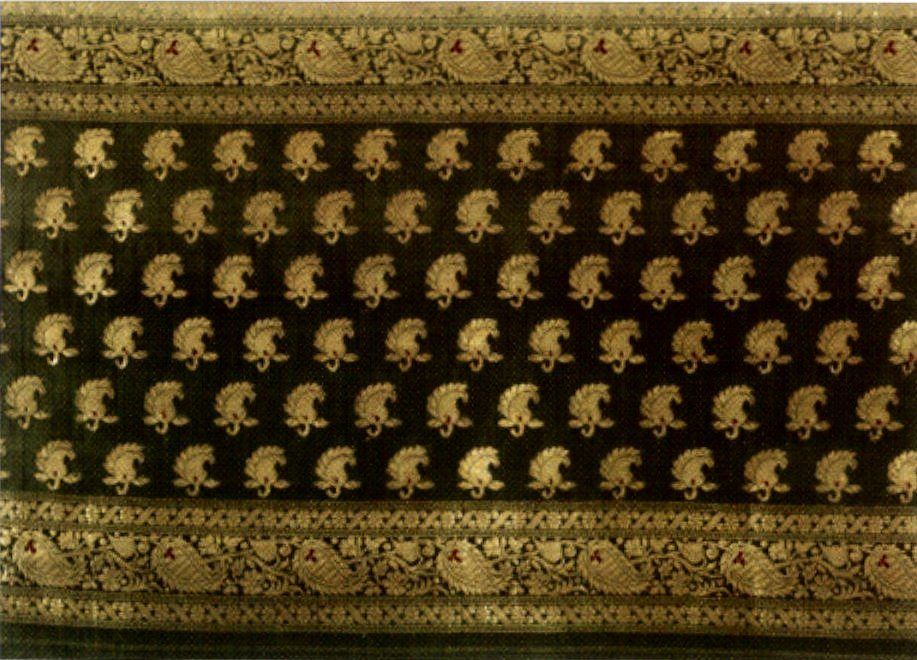
The silk brocades of Varanasi, woven with gold and silver zari in Mughal- influenced motifs — paisley butis, floral jangla trellises, hunting scenes — are the classic North Indian bridal sari. A fine handloom Banarasi can take weeks to months on the loom. The weaving community, largely hereditary artisan families, sustains one of India's most storied textile economies, now GI-protected against powerloom imitation.
Kanjeevaram Silk Kanchipuram, Tamil Nadu

Tamil NaduGI-protected

From the temple town of Kanchipuram come South India's grandest saris: heavy mulberry silk with contrast borders and pallus joined by the interlocking korvai technique, and motifs drawn from temple architecture — checks, rudraksha beads, peacocks, temple spires. Worn at weddings and temple festivals, a Kanjeevaram is regarded as heirloom wealth, passed down generations.

Ikat — Patola, Pochampally & Sambalpuri Gujarat, Telangana, Odisha

Multiple statesResist-dyed yarn weaving

In ikat, the pattern is dyed into the yarns before weaving — a feat of mathematical planning. Gujarat's double-ikat Patola of Patan, made by the Salvi family lineage, dyes both warp and weft so patterns emerge perfectly aligned; a single sari can take months and historically travelled the spice routes to Indonesia. Telangana's Pochampally and Odisha's curving Sambalpuri bandha ikats carry the technique into thriving contemporary production.

Pashmina & the Kashmir Shawl Kashmir & Ladakh

Woven from the fine undercoat of the Changthangi goat of Ladakh's high plateaus, pashmina shawls — especially the twill-tapestry kani shawls woven with small bobbins, and those finished with hook embroidery (sozni) — were coveted from Mughal courts to Napoleonic Europe, where imitation "paisley" mills arose to copy their teardrop motif. Genuine hand-spun, hand-woven Kashmir pashmina is GI-protected.

Dye, Print & Resist Arts

India taught the world to fix colour to cotton.

Bandhani Gujarat & Rajasthan

Western IndiaTie-dye

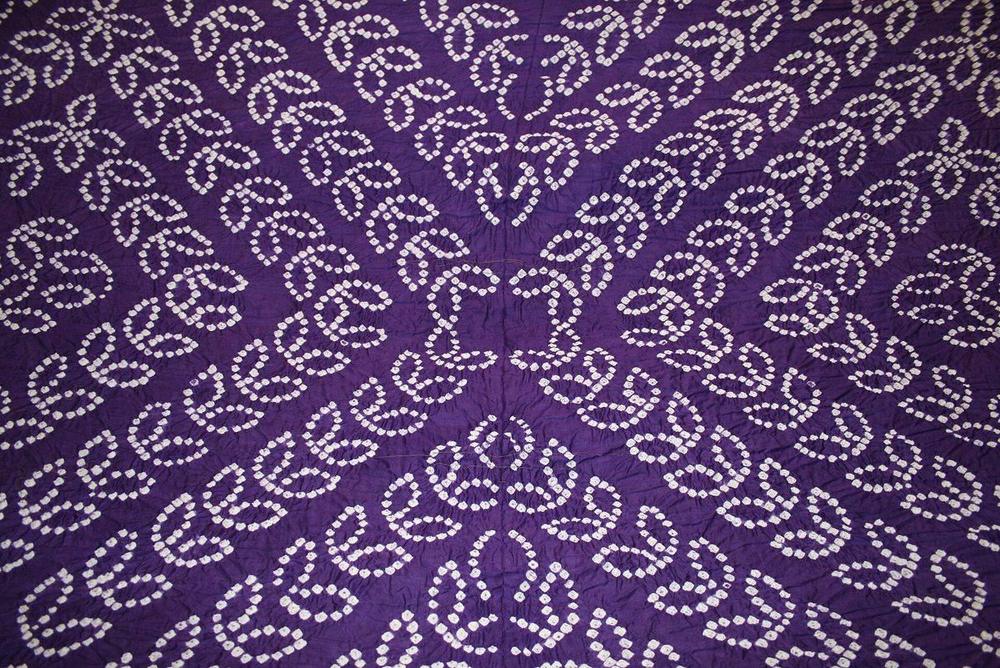
Thousands of tiny points of cloth are pinched and tied with thread before dyeing, blooming into constellations of dots — the auspicious reds and yellows of wedding odhnis, the gharchola and the leheriya wave-stripes of Rajasthan. Practised notably by the Khatri communities of Kutch, bandhani is among the world's oldest resist-dye traditions, with several regional GI tags.

Block Printing — Sanganer, Bagru & Ajrakh Rajasthan & Kutch

Rajasthan & GujaratHand-carved wooden blocks

Hand-carved teak blocks stamp running yardage with floral butis (Sanganer's fine prints on white), earthy black-and-red geometry (Bagru's mud-resist dabu), and the complex indigo-madder universe of Ajrakh — the multi-stage resist-printed cloth of the Khatri printers of Kutch and Sindh, whose geometry echoes Islamic star patterns. Natural-dye revivalists have made these printing towns global design destinations.

Embroidery Traditions

Needlework as regional signature.

Chikankari Lucknow, Uttar Pradesh

Lucknow's white-on-white shadow embroidery — delicate floral vines in dozens of named stitches (bakhiya, murri, jali openwork) on fine muslin. Tradition links its courtly flowering to Nawabi Lucknow and, in popular legend, to Mughal empress Nur Jahan. Once men's court dress, chikankari today employs hundreds of thousands of artisans, most of them women.

Phulkari & Kantha Punjab & Bengal

Punjab & BengalDomestic heirloom embroidery

Punjab's phulkari ("flower-work") covers coarse cotton with sheets of glowing silk floss in geometric darn stitch — the fully-covered bagh ("garden") made by grandmothers for a bride's trousseau, sung about in Punjabi folk songs. Bengal's kantha layers worn-out saris and quilts them with running stitch into story-covered cloths of lotuses, elephants and village life — thrift transformed into art, now a celebrated fashion embroidery.

Zardozi & Kashida courtly metal & Kashmiri needlework

Lucknow, Delhi, KashmirCouture heritage

Zardozi — Persian for "gold embroidery" — raises dense metal-thread reliefs of sequins, wire coils and beads on velvet and silk; it adorned Mughal courts and now anchors Indian bridal couture and film costume. Kashmir's kashida/sozni embroidery flows chinar leaves and paisleys across shawls in impossibly fine stitches, while the hooked aari style speeds flowering vines across pherans and drapes.

Metal, Clay, Wood & Toys

Sculptural crafts of the workshop and the forge.

Bidriware Bidar, Karnataka

KarnatakaGI-protected

A metalcraft unique to Bidar: vessels cast from a zinc-copper alloy, engraved with flowing floral and geometric designs, inlaid with pure silver, then blackened with a special soil-based patina traditionally taken from the old fort — the silver blazing against velvet black. Flourishing under the Deccan sultanates with Persian influence, bidriware remains one of India's most elegant metal arts.

Dhokra Central & Eastern India

Chhattisgarh, Odisha, Bengal, JharkhandLost-wax bronze

Tribal metal-smiths cast figures of deities, elephants, horses and lamps by the ancient lost-wax (cire perdue) method — wax threads coiled over a clay core give Dhokra its signature wiry texture. The technique family is often compared to that of the famous Mohenjo-daro "Dancing Girl" bronze, testifying to millennia of continuity; today craft clusters in Bastar and Bengal supply collectors worldwide.

Blue Pottery Jaipur, Rajasthan

Jaipur's famous turquoise-and-cobalt ceramics use no ordinary clay: the ware is shaped from a quartz-based frit paste in a technique with Persian–Central Asian roots that reached Jaipur via royal patronage in the 19th century. Revived in the 20th century when it neared extinction (artist-craftsman Kripal Singh Shekhawat, Padma Shri, was central to the revival), its floral tiles, vases and doorknobs are now a Jaipur signature.

Channapatna Toys, Kondapalli & Terracotta Karnataka, Andhra & beyond

Multiple statesToy & votive traditions

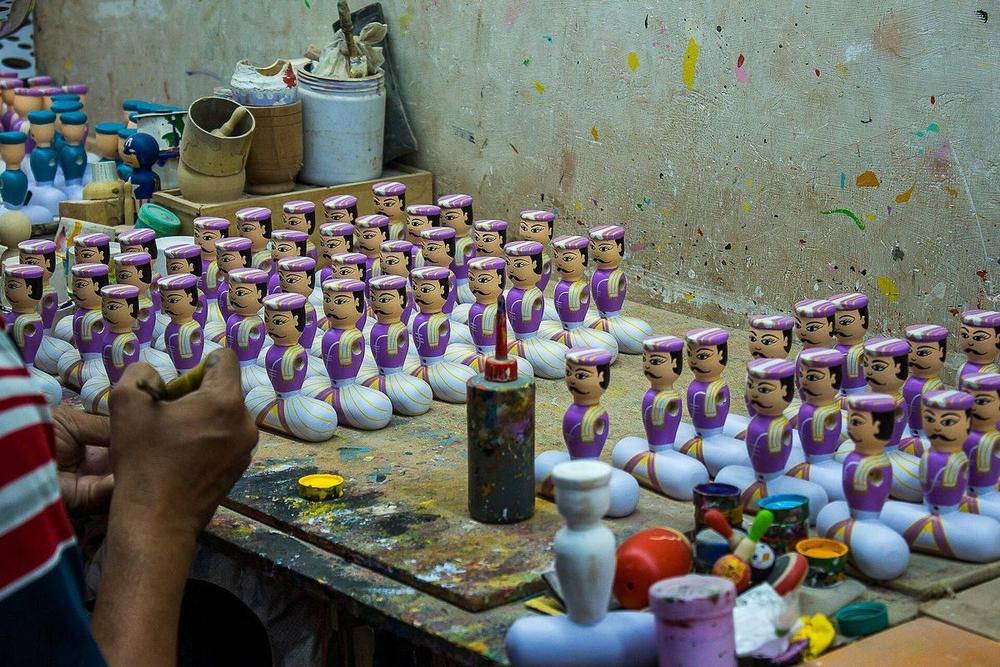
Karnataka's Channapatna "toy town" turns hale wood on lathes and colours it with lac and natural dyes — a craft tradition popularly traced to Tipu Sultan's era, now GI-protected. Andhra's Kondapalli carvers build featherlight painted figures of village life and mythology from softwood. And across India, terracotta remains the people's sculpture — from Bengal's Bankura horses to the monumental votive horses offered to the god Ayyanar in rural Tamil Nadu.

Stone & Wood Carving pan-India

Pan-IndiaTemple-craft lineages

The lineages that carved Khajuraho, Konark and the Hoysala temples survive in living clusters: Odisha's stone carvers around Puri and Bhubaneswar, Mahabalipuram's granite sculptors in Tamil Nadu (heirs to Pallava ateliers), Rajasthan's marble and sandstone jali (lattice) workers, Kashmir's walnut-wood carvers, and Saharanpur's vast woodcraft industry. Temple-building traditions such as the Sompura community of Gujarat still raise new temples by canonical rules — sculpture as an unbroken profession.

A note on accuracy: Craft origin stories (Nur Jahan and chikankari, Tipu Sultan and Channapatna) are traditional attributions, noted as such. GI statuses reflect widely reported listings; verify current registrations with India's official GI registry. Content last reviewed: July 2026 · See Sources & References.