Wing I — Karnataka
The home wing — objects from the state's stages, shrines and workshops.
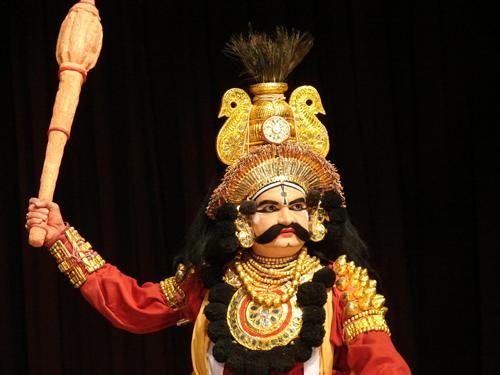
Yakshagana Kirita Coastal Karnataka
The towering crown of Yakshagana, built up of carved wood, cloth, gilt and mirror-work. Each character type has its own headgear — the grander the crown, the mightier the role. With the make-up and ornaments, a performer carries this splendour through a dusk-to-dawn performance. Deep dive: Yakshagana →
Image: Wikimedia Commons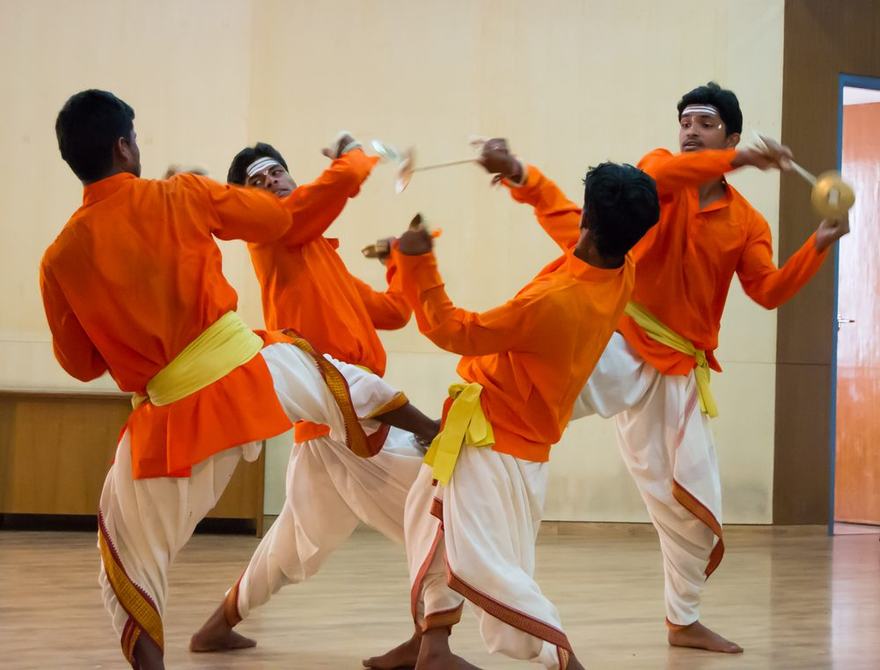
Kamsale Southern Karnataka
A pair of bronze discs — one a cymbal, one a beater — that are instrument, prop and offering at once. Devotees of Male Mahadeshwara sing the deity's ballads while the kamsale flashes and rings in patterns that grow breathtakingly acrobatic.
Image: Wikimedia Commons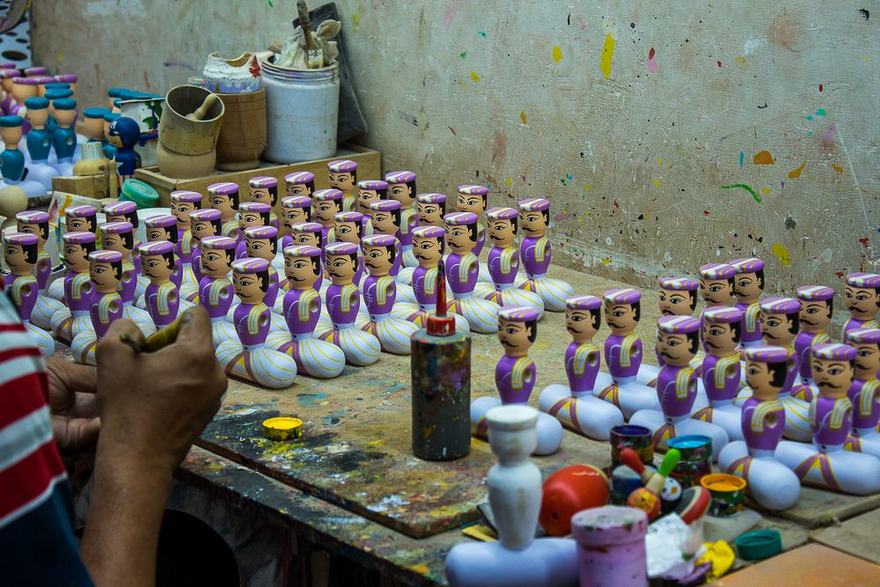
Channapatna Toys Channapatna, Karnataka
Lacquered wooden toys from the "toy town" on the Bengaluru–Mysuru road — turned on the lathe, coloured with lac, and polished till they glow. A GI-tagged craft whose workshops still paint each face by hand, as this artisan is doing.
Image: Wikimedia CommonsWing II — Kerala & Tamil Nadu
Where drums lead processions and even make-up is an art with rules.
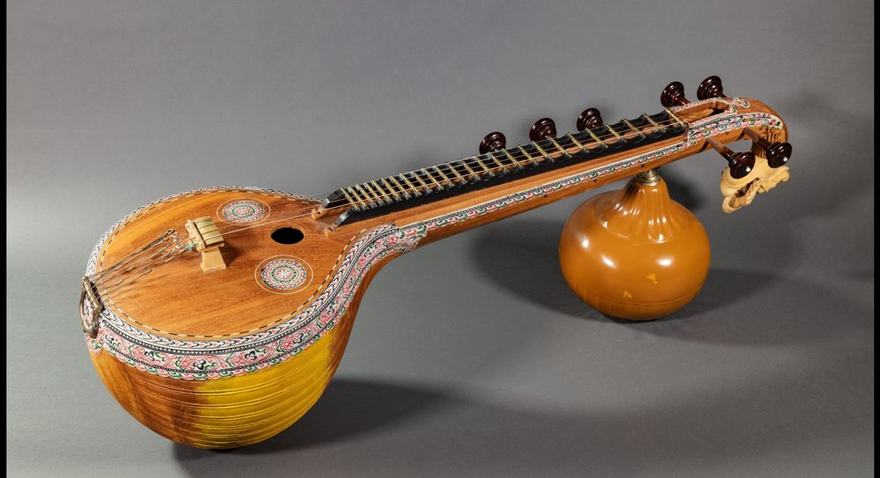
Saraswati Veena Tamil Nadu
The grand plucked string instrument of Carnatic music — a large resonator, a fretted neck, a gourd to rest on the lap, and a carved yali at the head. Thanjavur's makers are especially famed; a fine veena may be carved from a single block of jackwood.
Image: Wikimedia Commons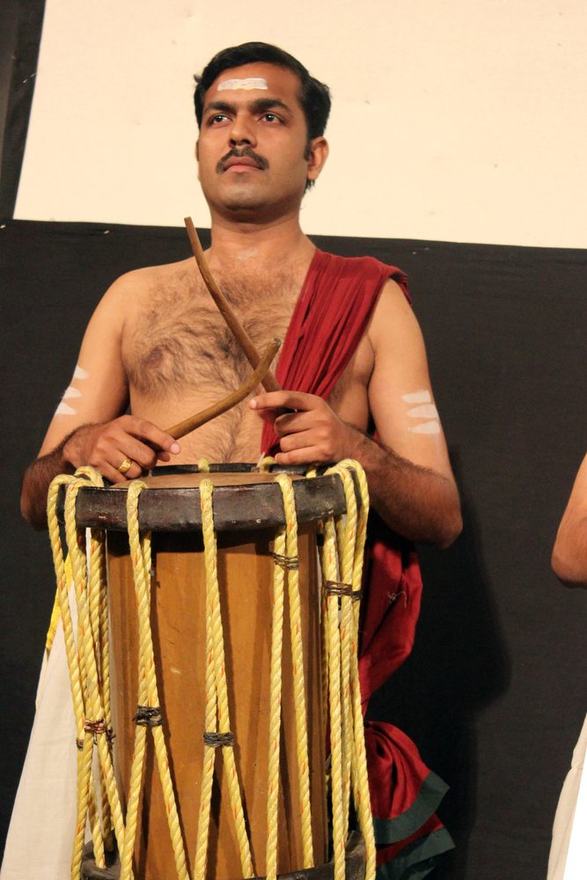
Chenda Kerala
Kerala's cylindrical drum, slung upright and struck with curved sticks. Its ringing crack carries over temple courtyards and leads Kathakali's drama; massed chenda ensembles at festivals are among the loudest unamplified sounds in Indian music.
Image: Wikimedia Commons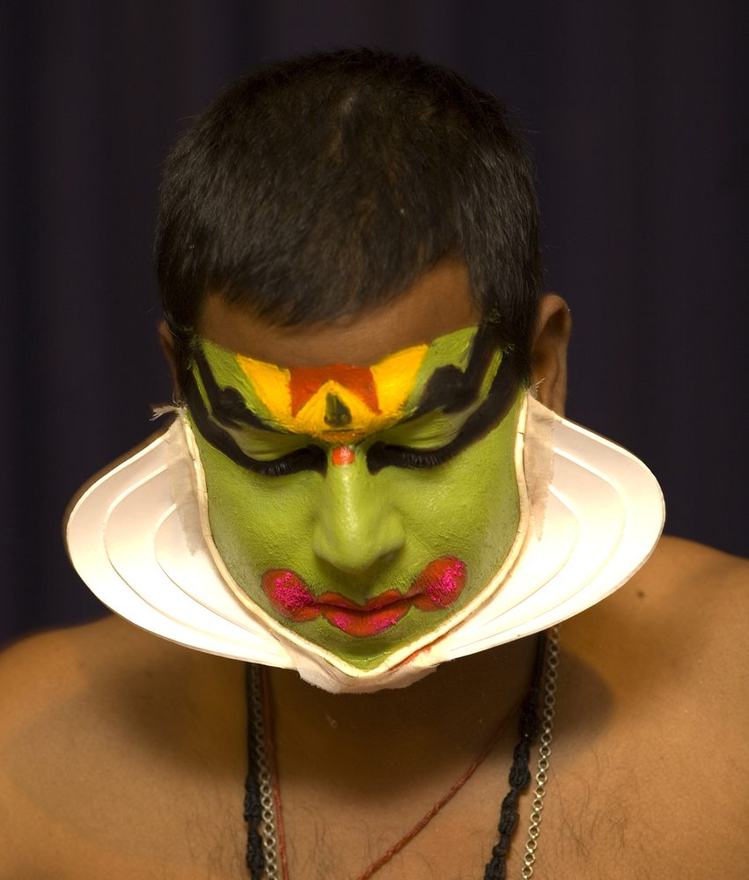
Kathakali Pacha & Chutti Kerala
Before the crown comes hours of make-up. The green pacha face marks a noble hero; the white chutti ridge framing the jaw is built up layer by layer from paper and rice paste by a specialist artist. The painted face is a mask that can still move.
Image: Wikimedia Commons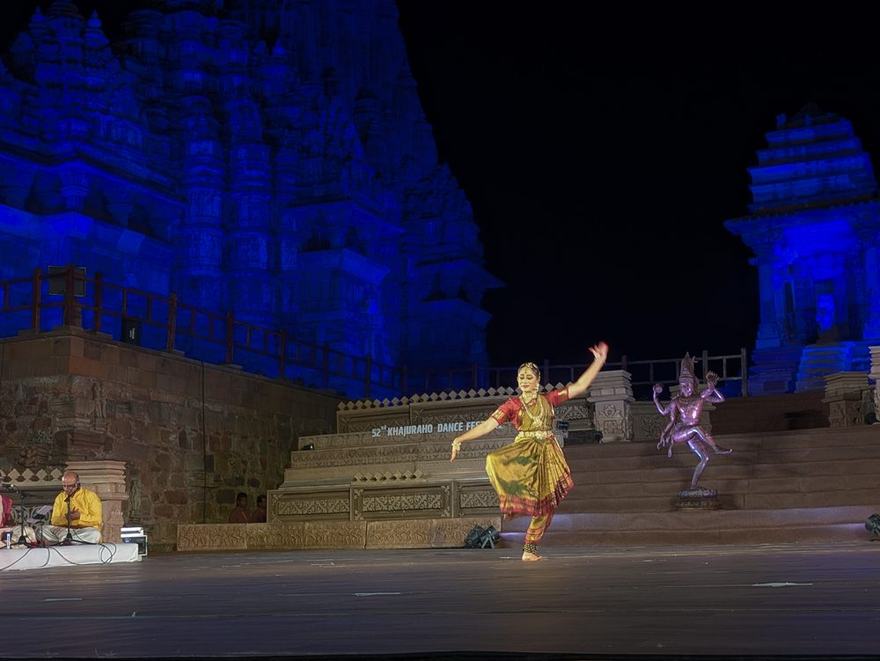
Bharatanatyam Costume & Temple Jewellery Tamil Nadu
The pleated fan that opens with every bend of the knees, and the "temple set" of jewellery — headpiece with sun and moon, necklaces, belt and bells — echoing the ornaments of temple deities. Here worn on stage at the Khajuraho Dance Festival, a Nataraja watching from the steps.
Image: Wikimedia CommonsWing III — North India
The Hindustani world of Devangi's own training — bells, strings and drums.
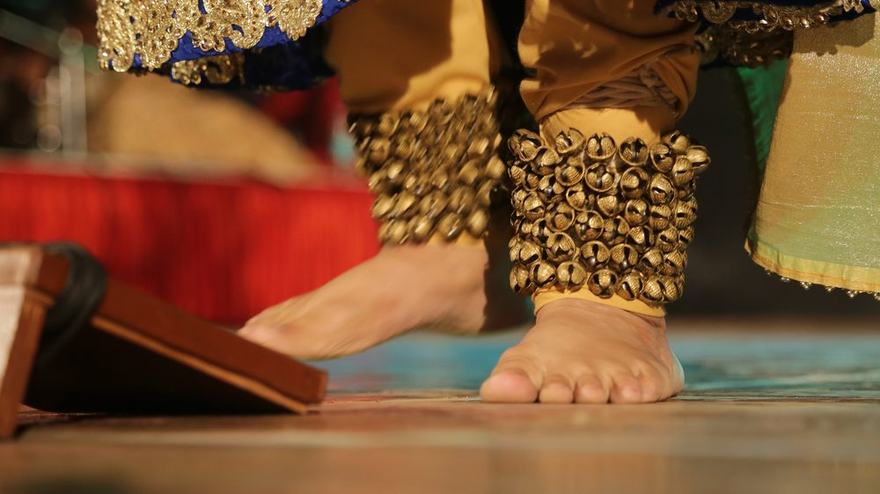
Ghungroo North India
Rows of small brass bells bound at the ankle — the voice of a Kathak dancer's feet. Dancers add bells as their training deepens, often reaching a hundred or more on each ankle; tied on with a moment of respect, they turn tatkar footwork into music. Deep dive: Kathak →
Image: Wikimedia Commons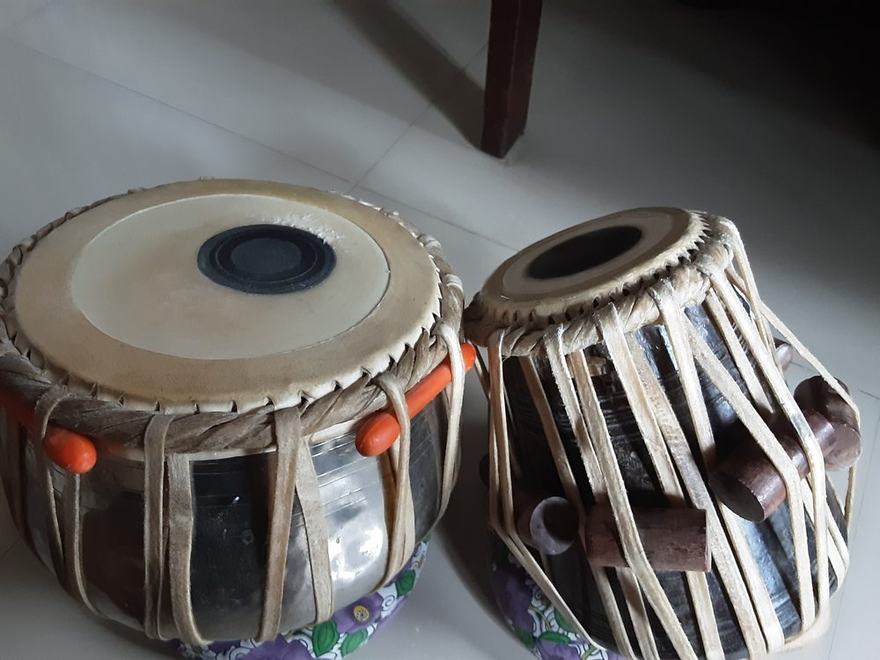
Tabla North India
The two-drum heart of Hindustani rhythm: the wooden dayan for the right hand, the metal bayan for the left. The black syahi disc on each head — a dried paste applied in layers — is what gives the tabla its speaking, singing tone. Deep dive: Tabla →
Image: Wikimedia Commons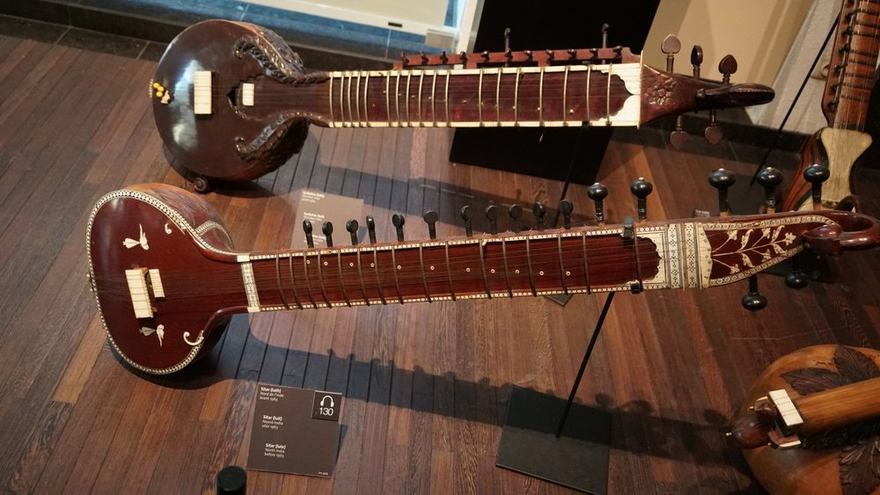
Sitar North India
The best-known voice of Hindustani strings — a deep gourd, a long hollow neck, curved movable frets, and strings that are never struck but bent, so a single fret can yield a whole phrase. Beneath the main strings run sympathetic strings that shimmer in reply. Deep dive: Sitar →
Image: Wikimedia Commons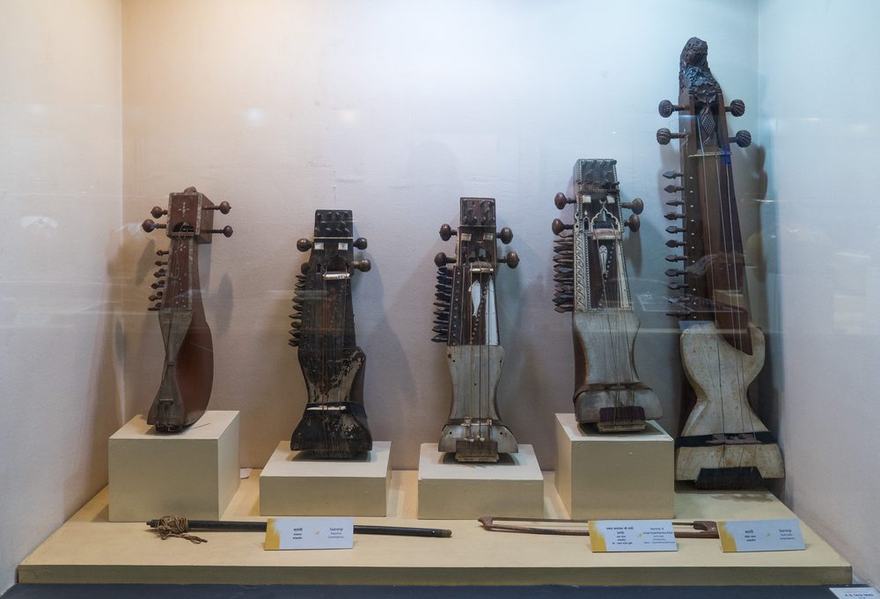
Sarangi North India & Rajasthan
Carved from a single block, bowed rather than plucked, and strung with dozens of sympathetic strings, the sarangi is often called the closest instrument to the human voice. This museum case shows how its shape shifts from region to region — five sarangis, five accents.
Image: Wikimedia Commons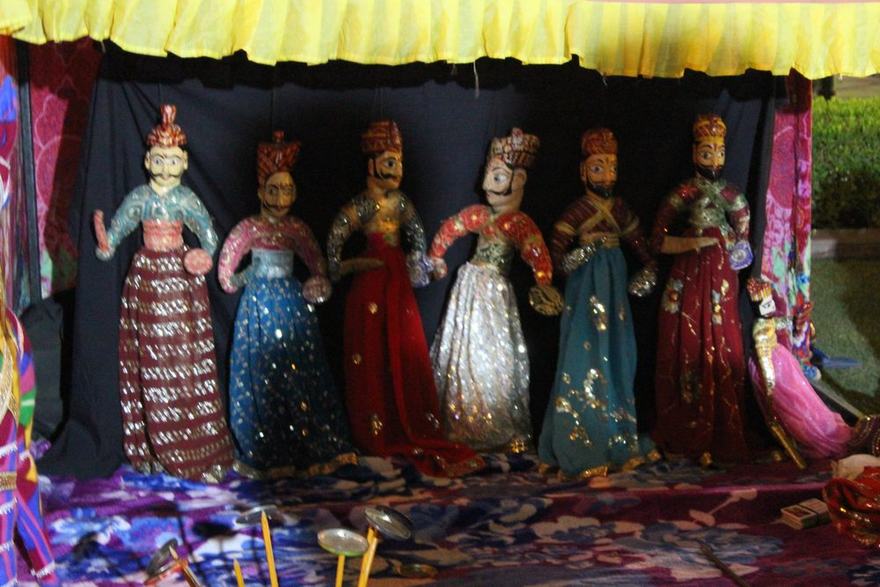
Kathputli Rajasthan
Rajasthan's string puppets — carved wooden heads, painted faces, long swirling skirts — traditionally made and performed by the Bhat community, whose travelling shows carried ballads of kings and heroes from village to village.
Image: Wikimedia CommonsWing IV — East & Northeast
Masks that transform, skirts that turn dancers into temples, and one humble string.
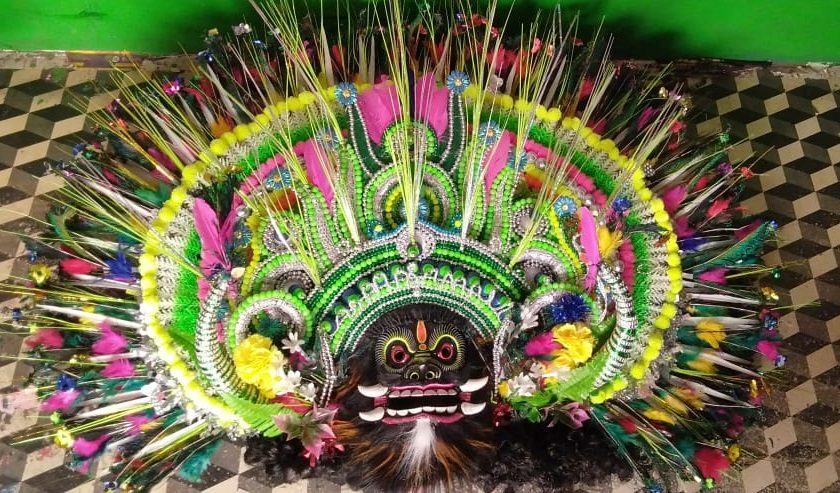
Chhau Mask Purulia, West Bengal
The great masks of Purulia Chhau, crowned with halos of beads, tinsel and feathers that can spread wider than the dancer's shoulders. Made of layered paper, cloth and clay by hereditary mask-maker families, they turn acrobatic dancers into gods and demons — a GI-tagged craft in its own right.
Image: Wikimedia Commons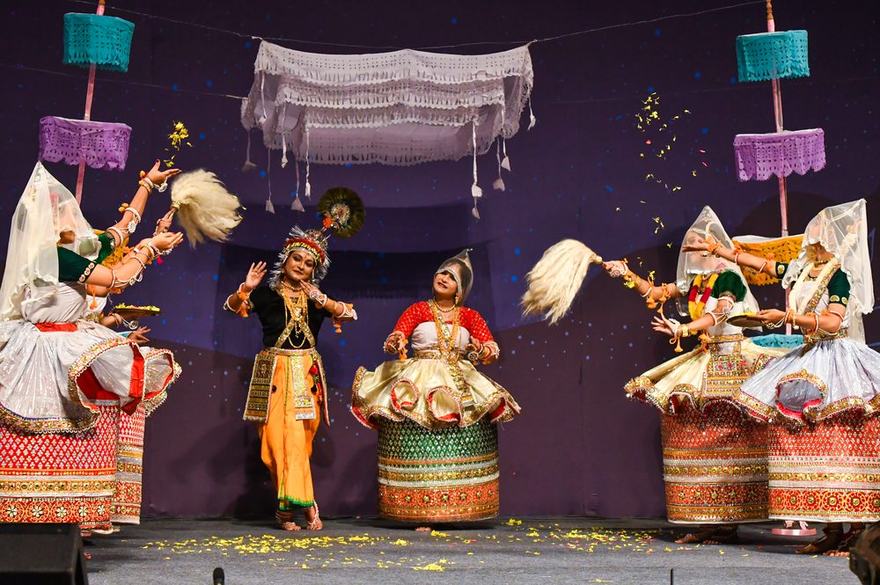
Potloi Manipur
The stiff, drum-shaped skirt of Manipuri Ras Lila — layers of embroidered, mirror-dotted cloth over a frame, above which the dancer seems to float. Tradition traces its design to the devotional court of the 18th-century king Rajarshi Bhagyachandra, who shaped the Ras Lila as it is danced today.
Image: Wikimedia Commons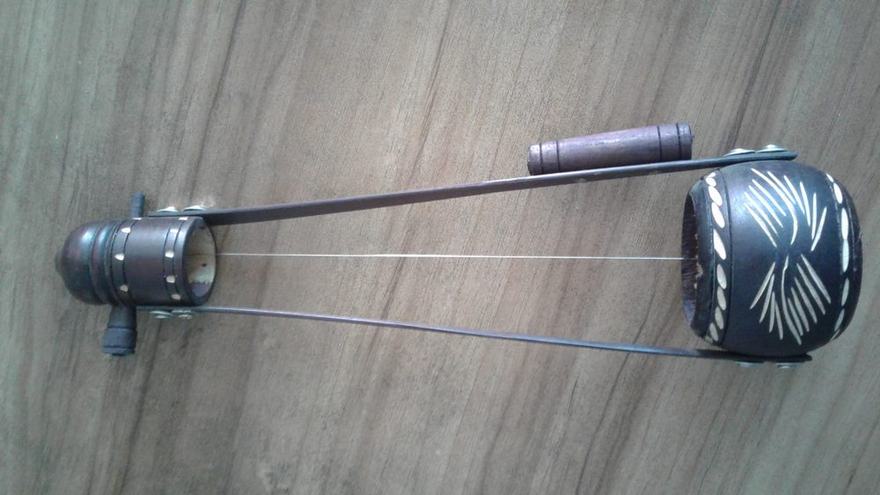
Ektara Bengal & beyond
One string, a small resonator, two springy arms — squeeze them and the pitch bends. The ektara (in Bengal often called gopiyantra) is the constant companion of the wandering Baul singers, proof that a whole world of music can hang on a single string.
Image: Wikimedia CommonsWing V — West India
Festivals you can hold in your hands.
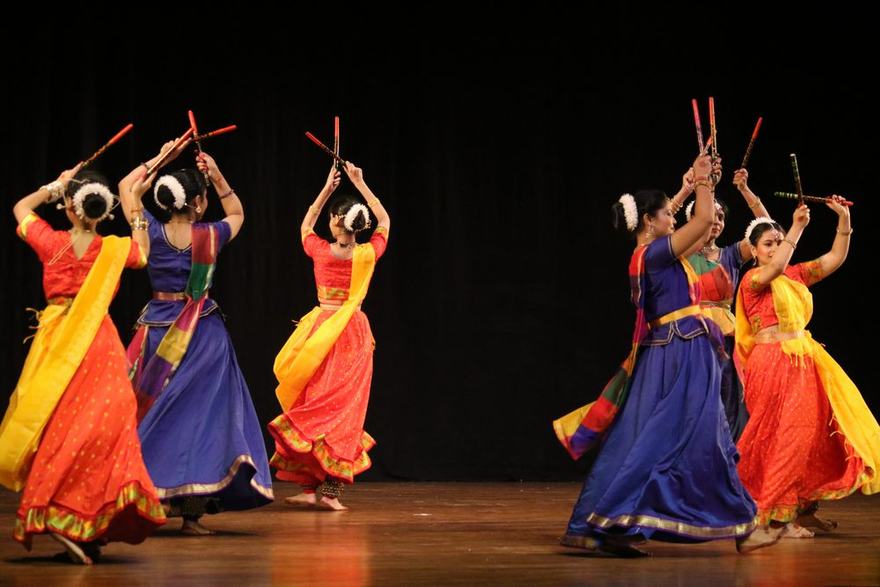
Dandiya Gujarat
A pair of turned, brightly painted sticks — Gujarat's great Navratri festival held in two hands. Struck against a partner's sticks in circling raas patterns, they echo a tradition that dancers trace to Krishna's raas lila; here taken up on the concert stage as well.
Image: Wikimedia Commons