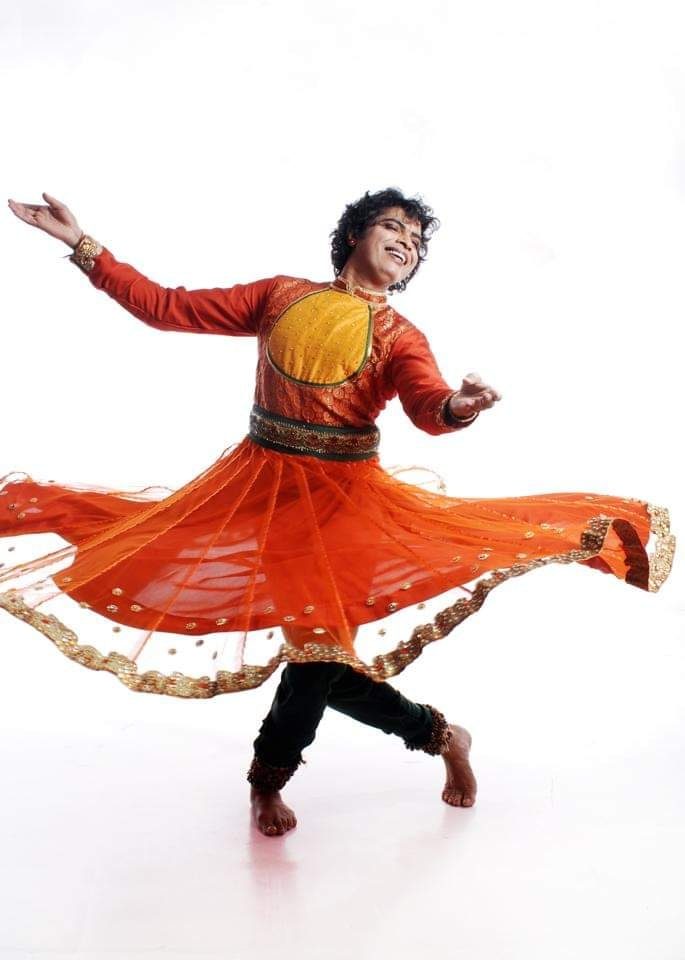
Bharata's treatise names eight rasas; later tradition —
especially through the philosopher Abhinavagupta — added a ninth, shanta. Each rasa rests
on its sthayi bhava, the stable human emotion beneath it.
Shringara · शृङ्गार
Love, beauty, longing — from rati (love)
The "king of rasas": romantic and divine love alike — Radha waiting for Krishna,
the hero's glance, the ornamented world of beauty itself.
Meet it in: thumri,
Kathak's gat-bhava, Pahari miniatures of Radha-Krishna.
Hasya · हास्य
Laughter, mirth — from hasa (merriment)
Comedy in all shades, from gentle smile to helpless laughter — often carried by
the wise jester who tells truths no one else may.
Meet it in: the vidushaka of
Koodiyattam, Bhavai's satires,
puppet comedies.
Karuna · करुण
Compassion, pathos — from shoka (sorrow)
Grief transformed into shared tenderness — the rasa that makes an audience weep
for Sita's exile or a mother's loss, and leave gentler.
Meet it in: vilambit khayal,
Sita's lament in Ramlila, Baul songs of separation.
Raudra · रौद्र
Fury — from krodha (anger)
Cosmic and human wrath — the blazing eyes and thundering steps of the righteous
or the terrible enraged.
Meet it in: Veeragase's
Veerabhadra, Kathakali's red-bearded characters,
tandava passages.
Veera · वीर
Heroism — from utsaha (valour, zeal)
The lifted chest of courage: generosity, determination and battle-glory — the rasa
of heroes and of those who protect.
Meet it in: Yakshagana's
warriors, powada ballads,
Pandavani's Bhima.
Bhayanaka · भयानक
Terror — from bhaya (fear)
The prickle at the back of the neck — darkness, the demon's approach, the forest at
night — fear made safe enough to taste.
Meet it in: Theyyam's
fierce deities, night scenes of shadow puppetry,
Kathakali's demonesses.
Bibhatsa · बीभत्स
Disgust — from jugupsa (revulsion)
Art's power to make us recoil — at cruelty, decay, the repellent — and through
recoiling, to value the good.
Meet it in: the grotesque figures of epic battle
scenes in Kathakali and
Therukoothu.
Adbhuta · अद्भुत
Wonder — from vismaya (astonishment)
The open mouth of amazement — miracles, revelations, the vishwaroopa, the
impossible made visible.
Meet it in: Krishna's cosmic form in
Krishnanattam, a
tihai landing perfectly on sam, temple
spectacle.
Shanta · शान्त
Peace — from shama (tranquillity)
The ninth rasa, championed by Abhinavagupta: the stillness beyond all emotions,
where art becomes contemplation — many say the rasa into which all others finally
dissolve.
Meet it in: dhrupad
alap, the Buddha in Ajanta's murals, the tanpura's
drone itself.