Theatre & Storytelling

रंगमंच — the stage as temple, the story as inheritance

The Natya Shastra treats theatre as the "fifth Veda" — an art open to all, made from all the others. India's performance traditions range from the world's oldest continuously performed Sanskrit theatre to village dance-dramas, ritual possession performances, puppetry of every kind, and bardic storytelling that keeps epics alive without a single written page.

❖ ❖ ❖
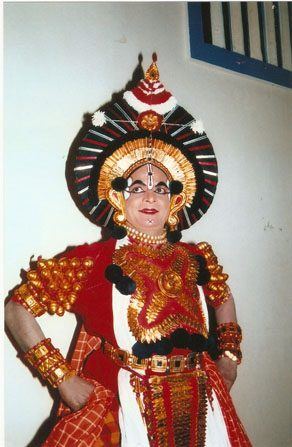
Kathakali face with golden headdress
Jump to: Classical & Ritual Folk Theatre Puppetry Storytelling Modern Stage

Classical & Ritual Theatre

Koodiyattam Kerala

KeralaUNESCO ICHSanskrit theatre

History & Details

Koodiyattam ("acting together") is widely described by scholars as among the world's oldest continuously performed theatre traditions — Sanskrit drama staged in Kerala's temple theatres (koothambalams) for perhaps a thousand years or more by hereditary Chakyar and Nangiar communities. A single act can be elaborated over many nights; the actor's art of abhinaya — eyes, breath and micro-expression — reaches its most refined extreme here, accompanied by the thunderous mizhavu copper drum. It was among the first traditions UNESCO proclaimed as a Masterpiece of Intangible Heritage (2001). The related solo forms Chakyar Koothu and the women's Nangiar Koothu belong to the same family.

People: Guru Ammannur Madhava Chakyar and Painkulam Rama Chakyar (who controversially and courageously took the art beyond temple walls); Margi Sathi among noted Nangiar Koothu performers.
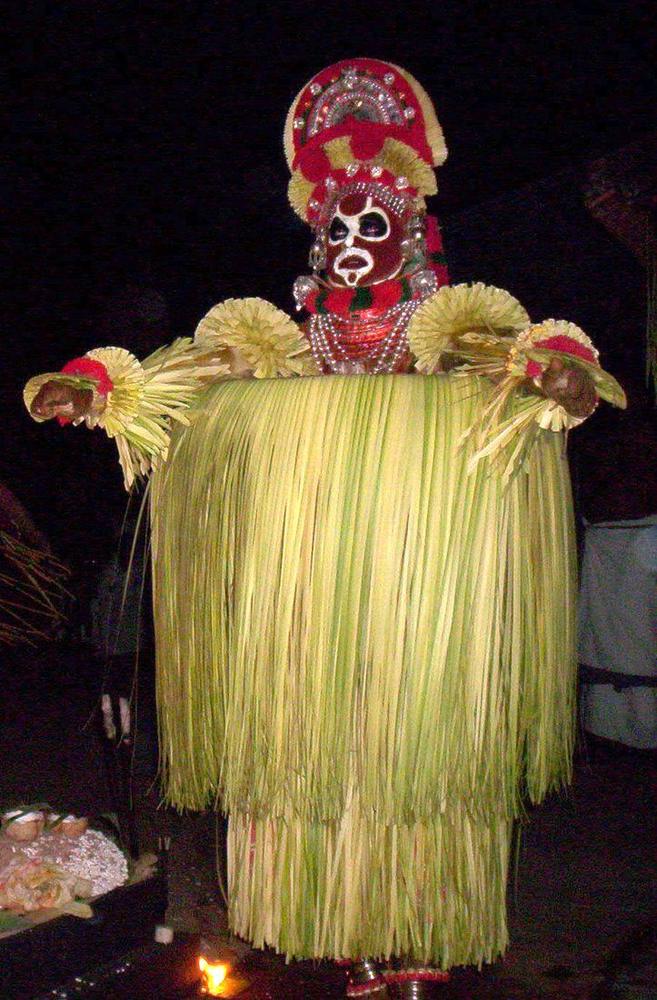
Theyyam North Kerala

Malabar, KeralaRitual embodiment

In the village shrines of Malabar, performers from historically marginalised communities become gods: after intense ritual preparation, towering headgear and flame-orange makeup, the Theyyam dancer is treated as the deity embodied, blessing devotees of every caste — a striking inversion of social hierarchy. Hundreds of distinct Theyyams (deified heroes, goddesses, serpent and animal spirits) are performed in the temple season from roughly October to May.

Kalaripayattu Kerala

KeralaMartial art — mother of movement

Kerala's ancient martial art — often described as one of the oldest surviving fighting systems in the world — trained in the kalari, a consecrated earthen training pit. Students progress from body-conditioning sequences and leaps through staff and weapon forms to the legendary flexible sword (urumi), supported by the tradition's own system of massage and treatment (kalari chikitsa). Kalaripayattu matters doubly to the performing arts: its training methods and movement vocabulary underpin Kathakali and inform Theyyam and Koodiyattam performers — the martial root beneath Kerala's theatrical tree. Northern and southern styles carry distinct techniques and lineages.

Yakshagana Coastal Karnataka

KarnatakaNight-long dance-drama

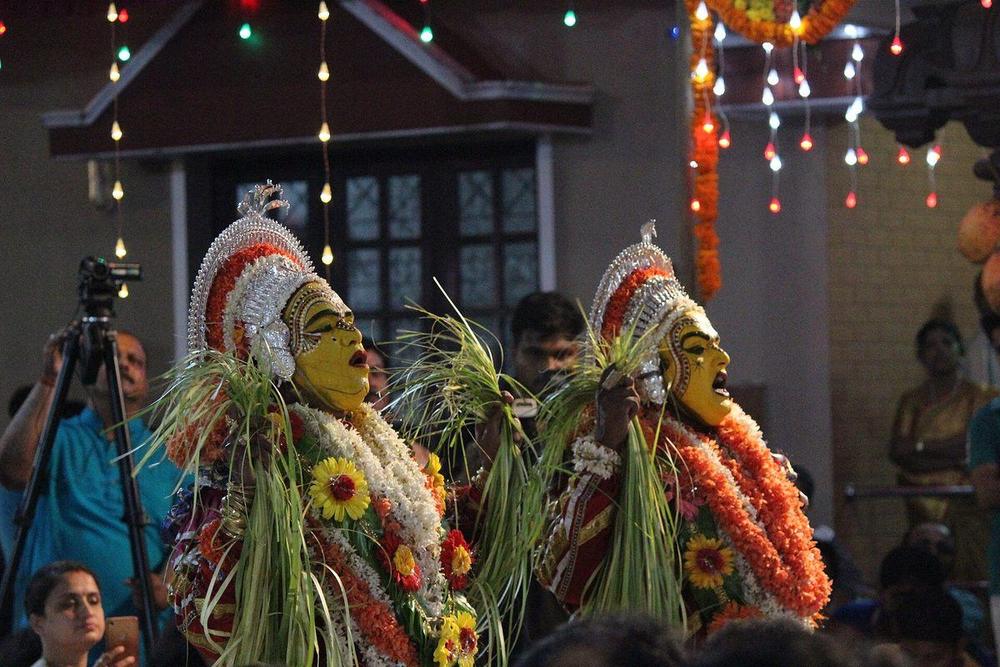
Coastal Karnataka's spectacular dance-drama: blazing costumes, towering headdresses, percussive dance and extempore dialogue staging the epics from dusk to dawn in paddy-field arenas. A singer-director (bhagavata) drives the show with drummers on chende and maddale. Distinct northern (badagutittu) and southern (tenkutittu) styles thrive, along with all-night "tent" troupes; Shivarama Karanth's experiments and star performers such as Chittani Ramachandra Hegde (Padma Shri) carried it to national attention.

Ramlila & Krishnattam North India & Kerala

Ramlila — the autumn folk enactment of the Ramayana based on Tulsidas's Ramcharitmanas, culminating in the burning of Ravana's effigy at Dussehra — is performed in thousands of towns; the month-long Ramnagar Ramlila across the river from Varanasi, patronised by the Kashi royal house, is its most celebrated form, and UNESCO inscribed Ramlila as Intangible Cultural Heritage. Kerala's temple form Krishnanattam, an eight-night cycle on Krishna's life at Guruvayur temple, is a precious survivor of pre-Kathakali dance-drama.

Folk & Regional Theatre

Nautanki, Swang & Tamasha North & West India

UP, Haryana, MaharashtraOperatic folk stage

Nautanki, the operatic folk theatre of the Hindi belt, sets romances and heroic tales to soaring verse over the kettledrum nagara — before cinema, it was North India's mass entertainment. Swang of Haryana shares its sung-drama roots. Maharashtra's Tamasha blends lavani song-dance, comedy and social satire; its troupes, historically drawn from marginalized communities, remain a powerful (and debated) popular art.

Jatra & Bhavai Bengal & Gujarat

Bengal & GujaratTravelling troupes

Bengal's Jatra — melodramatic travelling theatre on open four-sided stages, born from Vaishnav processional performance and later a vehicle for mythologies, histories and political melodrama — still supports professional troupes touring village circuits. Gujarat's Bhavai, traditionally credited to the 14th-century figure Asaita Thakar, strings satirical playlets (vesha) through the night, mixing devotion to the goddess with biting comedy.

Therukoothu Tamil Nadu

Tamil NaduStreet theatre

"Street play" of northern Tamil Nadu: all-night village performances of Mahabharata episodes — especially the Draupadi cult cycle — with heavy makeup, mirrored costumes, whirling dance and full-throated song. Performed during temple festivals for the goddess Draupadi Amman, it fuses theatre with ritual: the audience are devotees, and the performance itself is an offering.

Puppetry Traditions

String, Shadow, Rod & Glove across India

Pan-IndiaFour great families

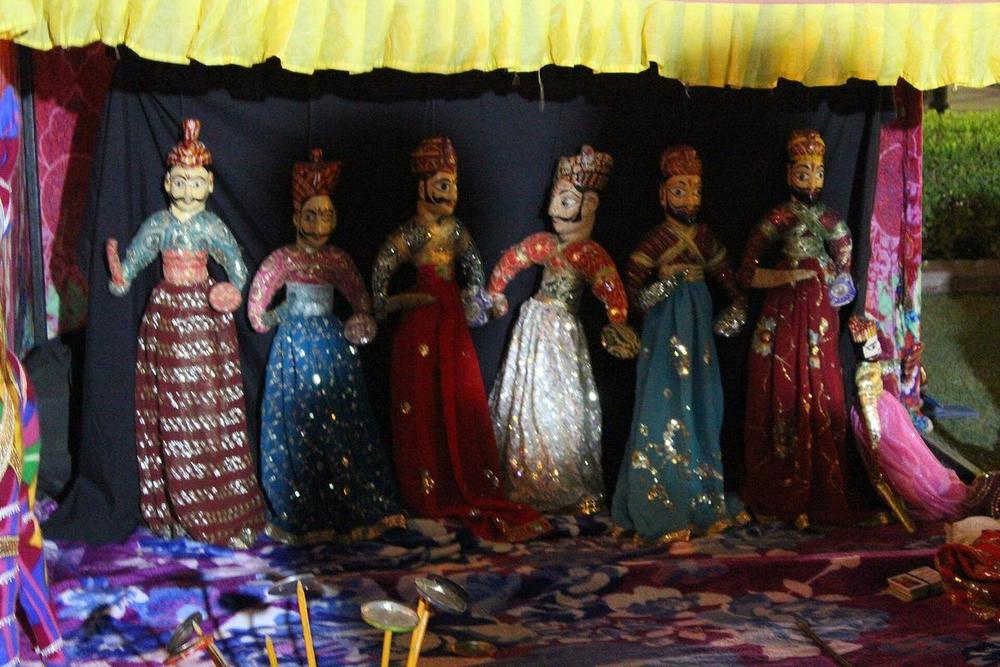
India holds all four classic puppet families. String: Rajasthan's Kathputli, jointless wooden marionettes flicked to life by Bhat community puppeteers with shrill boli-whistle voices; Tamil Nadu's heavier Bommalattam combines strings and rods. Shadow: leather silhouettes against lamplit cloth — Andhra's large, colourful, jointed Tholu Bommalata, Karnataka's Togalu Gombeyaata, Odisha's Ravana Chhaya and Kerala's Tholpavakoothu, whose temple performances of the Kamba Ramayana can run for many nights. Rod: Bengal's Putul Nach. Glove: Kerala's Pavakathakali, Kathakali in miniature. Once the village's cinema, puppetry survives through festivals, tourism and institutions such as the Sangeet Natak Akademi's puppetry awards.

Bardic & Narrative Arts

Harikatha & Kathakalakshepam South India

South IndiaDiscourse-with-song

A single performer weaves story, philosophy, humour and Carnatic music into a devotional discourse — an art refined in 19th-century Thanjavur (Ajjada Adibhatla Narayana Dasu in Telugu and Thanjavur Krishna Bhagavathar in Tamil are among its celebrated figures). Its northern cousins include the kirtankar tradition of Maharashtra and the Ram Katha and Bhagwat Katha discourses that still draw audiences of hundreds of thousands.

Pandavani Chhattisgarh

ChhattisgarhSolo epic singing

The Mahabharata sung solo with a tambura that becomes every prop — Bhima's mace, Arjuna's bow — in electrifying performance. Teejan Bai, who broke tradition by performing the vigorous kapalik style as a woman and rose from village performances to world stages (honoured with the Padma Vibhushan), made Pandavani internationally famous; Jhaduram Devangan is revered among its foundational modern masters.

Burrakatha, Villu Pattu & the Bhopa Epics Andhra, Tamil Nadu, Rajasthan

Multiple statesBallad traditions

Andhra's Burrakatha teams a lead singer-narrator with two drummers in tales sacred and political — it was famously used for social messaging in the independence era. Tamil Nadu's Villu Pattu ("bow song") strikes its melodies on a huge bell-strung bow. In Rajasthan, Bhopa bards sing the epic of Pabuji before the painted phad scroll through the night — a full multimedia epic performance centuries before the term existed.

The Modern Indian Stage

From IPTA to Contemporary Theatre 20th century onward

Pan-IndiaUrban & experimental

Modern Indian theatre grew through Parsi theatre's commercial spectacle, the leftist Indian People's Theatre Association (IPTA, 1940s), and post-Independence institutions — above all the National School of Drama under Ebrahim Alkazi. The "theatre of roots" movement wove folk forms into modern drama: Habib Tanvir's Naya Theatre with Chhattisgarhi performers, Girish Karnad's myth-steeped plays, Vijay Tendulkar's and Badal Sircar's social theatre, B. V. Karanth's music-theatre and Ratan Thiyam's Manipuri stagecraft. Their work completes the circle: village forms feeding the contemporary stage.

A note on accuracy: Ages claimed for ancient traditions ("2,000 years of Koodiyattam") are traditional estimates; documented continuity is centuries deep but exact antiquity is debated. Founder attributions (e.g., Asaita Thakar for Bhavai) are traditional. Verify details with the Sangeet Natak Akademi and academic sources. Content last reviewed: July 2026 · See Sources & References.