Ancient Indian theory classifies instruments into four families — tata (strings),
sushira (winds), avanaddha (membrane drums) and ghana (solid
percussion like cymbals). Behind every famous instrument stand generations of makers and
the maestros who gave it a voice on the world stage.
Plucked and bowed voices, from the meditative tanpura drone to the
sitar's cascading runs.
Sitar Hindustani
Plucked, long-necked luteNorth India
Among the best-known Indian instruments worldwide: a long-necked lute with a gourd resonator,
movable arched frets, playing strings and shimmering sympathetic strings that give its
halo of resonance. Its precise origin is debated — popular legend links it to Amir
Khusrau, but scholars generally trace its modern form to the 18th century. Ravi Shankar's
global concerts (and his association with The Beatles' George Harrison) made it an
international icon; Ustad Vilayat Khan developed the voice-imitating gayaki ang
style. Maestros: Ravi Shankar, Vilayat Khan, Nikhil Banerjee, Shahid
Parvez, Anoushka Shankar.
Go deeper: the sitar now has a full deep-dive page — anatomy, tuning, meend, gats and a learner’s first years. Read the Sitar deep dive →
Sarod Hindustani
Fretless plucked luteNorth India
A fretless lute with a polished steel fingerboard and goatskin-covered body, descended
from the Afghan rubab and developed in India in the 19th century (the Ghulam Ali Khan
lineage of Gwalior and, later, Allauddin Khan's Maihar tradition are central to its
history). Its fretless steel surface allows profound sliding meend; its tone is
deep and introspective. Maestros: Allauddin Khan, Hafiz Ali Khan, Ali
Akbar Khan (whom many rank among the greatest instrumentalists of the 20th century),
Amjad Ali Khan, Buddhadev Dasgupta.
Veena — Saraswati & Rudra Carnatic & Dhrupad
Ancient lute familySouth & North India
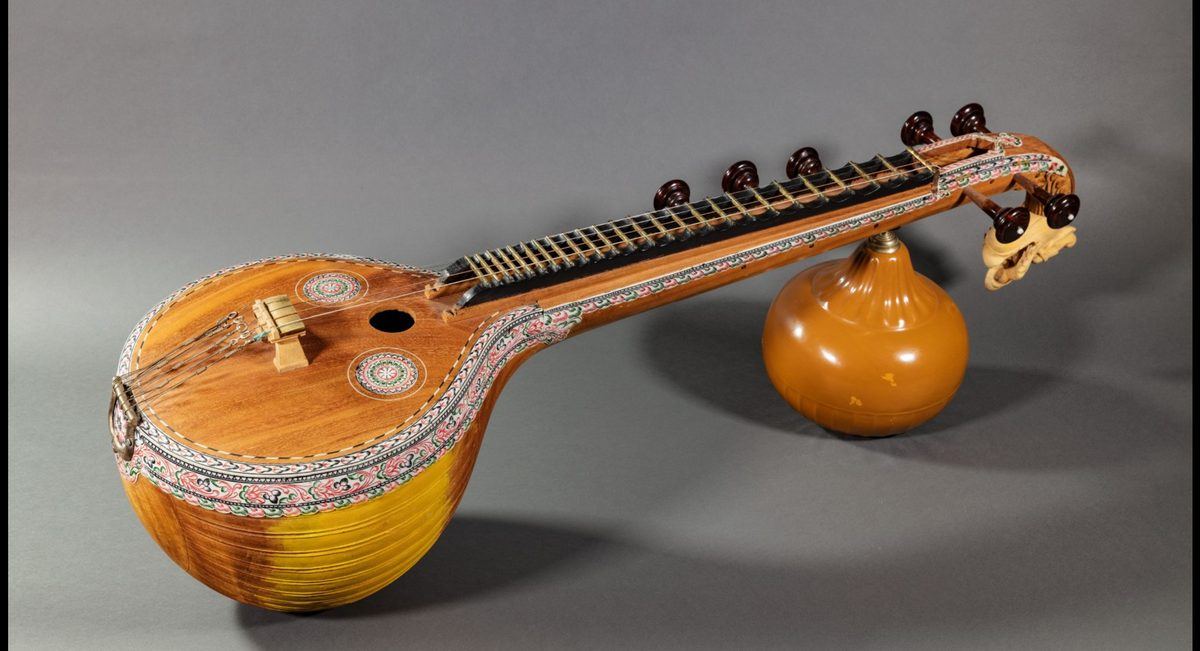
The Saraswati veena.
Photo via Wikimedia Commons (author & licence on source page)
"Veena" is the ancient umbrella name for Indian string instruments — the goddess
Saraswati is depicted holding one. The Saraswati veena, perfected in
Thanjavur, is the classical lute of Carnatic music, played seated with deep gamaka
(ornamental) technique. The Rudra veena, a large tube-zither with two
gourds, is the venerable instrument of dhrupad, prized for its profound sub-bass
meditation. Maestros: Veena Dhanammal, S. Balachander, Chitti Babu,
Emani Sankara Sastry (Saraswati veena); Zia Mohiuddin Dagar, Asad Ali Khan, Bahauddin
Dagar (Rudra veena).
Sarangi Hindustani
Bowed, ~40 strings totalNorth India
A short-necked bowed instrument carved from a single block of wood, with three main gut
strings and dozens of sympathetic strings, played by sliding the fingernails' cuticles
along the strings. Long the accompanist of vocalists and kathak dancers, it is often
called the instrument closest to the human voice. Pandit Ram Narayan established it as a
solo concert instrument; Ustad Sultan Khan and Ustad Bundu Khan are among its legends.
Santoor Kashmir → Hindustani
Hammered dulcimer, 100 stringsKashmir
A trapezoid hammered dulcimer of roughly a hundred strings struck with light wooden
mallets, long used in Kashmir's Sufiana music. Pandit Shivkumar Sharma adapted and
popularised it as a full classical concert instrument from the 1950s onward, developing
techniques to sustain and glide on an instrument of struck strings; his son Rahul Sharma
and Kashmir's Bhajan Sopori continued the tradition.
Violin & Tanpura adopted & foundational
Adopted from EuropeThe drone foundation
The European violin was adopted into Carnatic music around the early
19th century (Baluswami Dikshitar, brother of composer Muthuswami Dikshitar, is
traditionally credited among its pioneers) and, held against the chest in Indian posture,
became inseparable from the kutcheri; legends include Lalgudi Jayaraman, T. N.
Krishnan, M. S. Gopalakrishnan, and in Hindustani music N. Rajam. The humble
tanpura — four or more open strings plucked in cycle — provides the
continuous drone upon which all Indian classical music floats; its buzzing overtone-rich
timbre (shaped by the jivari bridge) is a sonic signature of the tradition.
Ancient & Rare Strings yazh, ravanhatta, surbahar & the slide veenas
Pan-IndiaHeritage & revival instruments
Behind the famous strings stands an older, rarer cabinet. The yazh,
the open-stringed harp praised in Sangam-era Tamil literature, faded centuries ago as
fretted lutes rose — modern makers are attempting revivals from textual and sculptural
evidence. Rajasthan's ravanhatta, the spike-fiddle of the Bhopa
bard-priests (its name traditionally linked to the legend of Ravana), is regarded in
tradition as an ancient ancestor of bowed strings. The surbahar — the
deep bass sitar — carries dhrupad-style alap in Hindustani music, famously played by
Annapurna Devi and Ustad Imrat Khan; the related sursingar served
similar depths for the rabab lineage. And the slide veenas — North India's fretless
vichitra veena and the Carnatic chitravina
(gottuvadyam), mastered by N. Ravikiran — sing pure glissando, melody with no frets at
all. Bengal's esraj, bowed cousin of the dilruba, remains the tender
voice of Rabindra Sangeet.
Winds — Sushira Vadya
Breath made melody — from Krishna's flute to the auspicious
double-reeds of temple and wedding.
Bansuri the bamboo flute
Side-blown bamboo flutePan-India
The transverse bamboo flute is inseparable from the image of Krishna, the divine
cowherd flautist, and appears in Indian art and text from antiquity. Pannalal Ghosh
pioneered the large concert bansuri for classical performance in the mid-20th century, and
Pandit Hariprasad Chaurasia carried it to world fame, including collaborations with
Western musicians. In Carnatic music the smaller venu tradition boasts masters such as
T. R. Mahalingam ("Mali") and N. Ramani.
Shehnai North India
Double reed — auspiciousNorth India
The North Indian double-reed oboe whose piercing-sweet tone is considered auspicious —
the traditional sound of weddings and temple gateways. Ustad Bismillah Khan, who played
for decades at Varanasi's temples and performed at India's first Independence Day
celebrations in 1947, single-handedly raised the shehnai to classical concert stature and
received the Bharat Ratna (2001). The related folk shehnai/ sundri traditions thrive
across the north and west.
Nadaswaram South India
World's loudest non-brass acoustic reed (traditional claim)Tamil Nadu
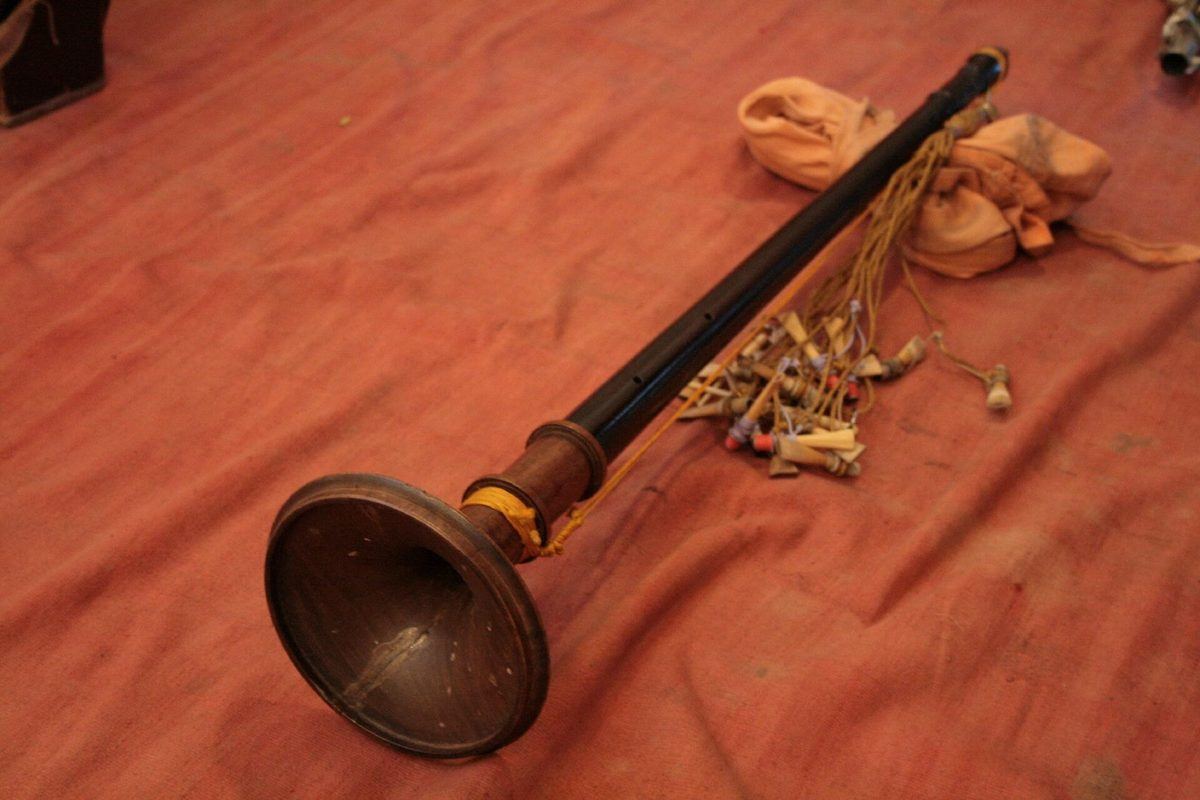
The nadaswaram.
Photo via Wikimedia Commons (author & licence on source page)
The long southern double-reed, grander and deeper than the shehnai, played with the
barrel-drum thavil at Tamil temple festivals and weddings — together called
mangala vadyam, "auspicious instruments." Its open-air power (often described,
traditionally, as the loudest non-brass acoustic instrument) suits processions around
temple streets. T. N. Rajarathinam Pillai is revered as its supreme modern master;
Sheik Chinna Moulana's lineage continues at Srirangam.
Percussion — Avanaddha & Ghana Vadya
India's drumming is a spoken art: every stroke has a syllable
(bol / solkattu), and drummers recite compositions before playing them.
Tabla Hindustani
Paired hand drumsNorth India
The paired drums of North India — the wooden treble dayan and metal bass
bayan — whose black tuning paste (syahi) enables precise pitch and a
vast palette of strokes. Its origin is debated (legend credits Amir Khusrau; scholars
generally date its rise to the 18th century, with Delhi's Sidhar Khan cited as a
foundational figure). Six main gharanas (Delhi, Ajrara, Lucknow, Farrukhabad, Banaras,
Punjab) developed distinct styles. Ustad Alla Rakha and his son Ustad Zakir Hussain made
tabla a global concert phenomenon; Pandit Kishan Maharaj and Pandit Anindo Chatterjee are
among its other greats.
Go deeper: the tabla now has a full deep-dive page — anatomy, bols, kayda to chakradhar, and the six gharanas. Read the Tabla deep dive →
Mridangam & Pakhawaj Carnatic & Dhrupad
Double-headed barrel drumsSouth & North India
The mridangam is the principal drum of Carnatic music — a two-headed
barrel drum of jackwood whose intricate mathematics of korvais and teermanams crowns every
kutcheri with the percussion dialogue of the tani avartanam. Legends include
Palghat Mani Iyer, Palani Subramania Pillai, Umayalpuram K. Sivaraman and Karaikudi Mani.
Its northern cousin the pakhawaj partners dhrupad singing and Odissi
dance with deep, dignified strokes.
Clay pot, lizard-skin tambourine, jaw harpSouth India
Carnatic concerts often feature an entire percussion section: the ghatam,
a fired clay pot played with fingers, palms and even tossed in display — made world-famous
by "Vikku" Vinayakram, who performed with the global fusion group Shakti; the
kanjira, a small tambourine of surprising depth; and the
morsing, a jaw harp that hums the tala. Their interplay in the tani
avartanam is a highlight of southern concerts.
Chenda, Dhol, Dholak & the drum map of India temple & folk drums
Pan-IndiaRitual & festival
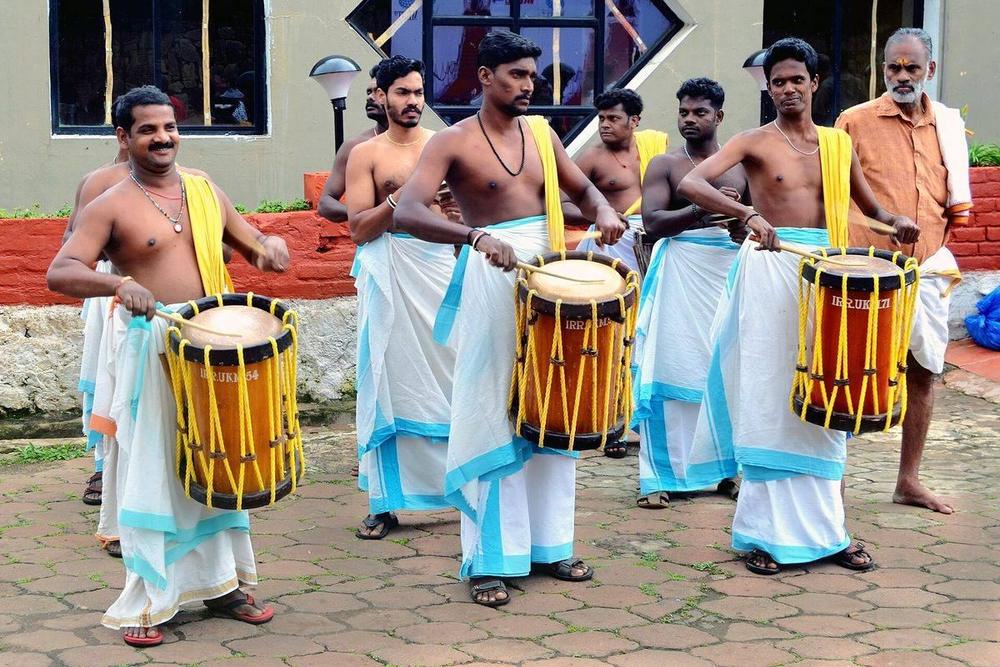
Chenda mela — Kerala's temple drum ensemble.
Photo via Wikimedia Commons (author & licence on source page)
Kerala's cylindrical chenda powers Kathakali and the temple drum
orchestras of Thrissur Pooram; the ensemble form Panchavadyam and the massed
chenda melam are art forms in themselves. Punjab's dhol drives
bhangra; the dholak is the heartbeat of folk song, qawwali and film
rhythm; Manipur's pung, Bengal's khol, Rajasthan's
nagara kettledrums and the tribal frame drums of central India each
anchor their own traditions — a reminder that in India, rhythm is regional dialect.
Jal Tarang, Algoza, Pena, Khartal & Dotara rarities across the families
Pan-IndiaRare & folk voices
Some of India's most magical sounds come from its rarest instruments. The
jal tarang — a crescent of porcelain bowls tuned with water and struck
with light sticks — is today played by only a handful of artists. Punjab, Sindh and
Rajasthan's algoza pairs two flutes played at once with circular
breathing, one droning while the other dances. Manipur's pena, a
one-string fiddle of bamboo and shell, opens the Lai Haraoba ritual and is the Meitei
community's oldest musical voice. The khartal — wooden clappers flashing
sixteenth-notes in Manganiyar hands — and Bengal's two-string dotara,
companion of Baul and Bhawaiya song, complete a cabinet every listener should meet at
least once.
A note on accuracy: Instrument origin stories (sitar, tabla) mix legend
with documented history; where debated, this page says so. Descriptive superlatives
reported from tradition (e.g., about the nadaswaram's loudness) are flagged as traditional
claims rather than measured facts.
Content last reviewed: July 2026 · See Sources & References.